


8 Hardwood Sports Flooring Mistakes That Can Cost Private Sports Facilities Revenue
Choosing a new hardwood sports floor seems simple enough.
Pick a surface. Compare quotes. Choose the one that looks good, performs well, and fits the budget.
But the wrong floor can get expensive fast.
A hardwood sports floor affects more than play. It affects court rentals, leagues, tournaments, camps, training sessions, maintenance, and the customer experience every time someone walks into the building.
The best floor is not always the cheapest one on installation day. It is the one that keeps working when the schedule is full, the building is busy, and downtime is not an option.
For leased facilities and growing sports businesses, it also needs to support change. The facility may expand. The layout may shift. The business may move.
That is why hardwood sports flooring should be treated as a long-term business decision — not just a construction purchase.
1. Choosing a Floor for One Sport Instead of Full-Day Utilization
Many owners start with one question: what sport is this space mainly for?
Basketball. Volleyball. Futsal. Pickleball. Dance. Camps. Events.
The better question is: what does this floor need to handle all day?
A private sports facility makes money by filling the same square footage with different programs. One court might host one sport in the morning, another after school, and host club training in the evening.
That is where multi-sport hardwood flooring becomes a business tool.
Pickleball is a good example. More facilities are adding it to their hardwood court setup because it can help fill quieter daytime hours. Older adults and recreational players may use the court in the morning. Youth can play basketball after school. Local clubs can train volleyball in the evening.
The floor earns more when it can serve more users.
A floor built for one activity limits what can be booked. Fewer booking options mean more empty hours.
Choose a hardwood sports floor system built for the business model, not just the first sport on the calendar.
2. Forgetting That the Facility May Need to Move, Expand, or Reconfigure
Private sports facilities change.
A basketball training business may add volleyball. A pickleball concept may expand into camps. A leased facility may outgrow its first location.
A permanent hardwood court may perform well, but if the business moves, the floor often stays behind. For a growing facility, that can turn a valuable surface into a sunk cost.
A relocatable sports floor gives owners another option. Junckers’ Clip System is a floating hardwood sports floor designed to be removed, relocated, reconfigured, and reinstalled as a facility grows or changes.
That makes it especially relevant for leased sports training facilities, pilot locations, and owners who want professional-level playability without giving up future flexibility.
The question is not only: what floor do we need now?
It is also: what happens to this investment if the business grows?
3. Underestimating Safety Zones Around the Court
Gym floor sizes and court dimensions are easy to find.
The space around the court is easier to overlook.
That is where many problems happen. Players chase balls past the boundary line. Kids run between activities. Coaches move equipment carts. Spectators get too close. Temporary seating appears during tournaments.
Suddenly, the area outside the lines matters almost as much as the court itself.
Safety zones around the playing area reduce risk and make the space easier to operate. A cramped layout creates safety issues, scheduling problems, and liability risk.
Plan for movement, not just markings.
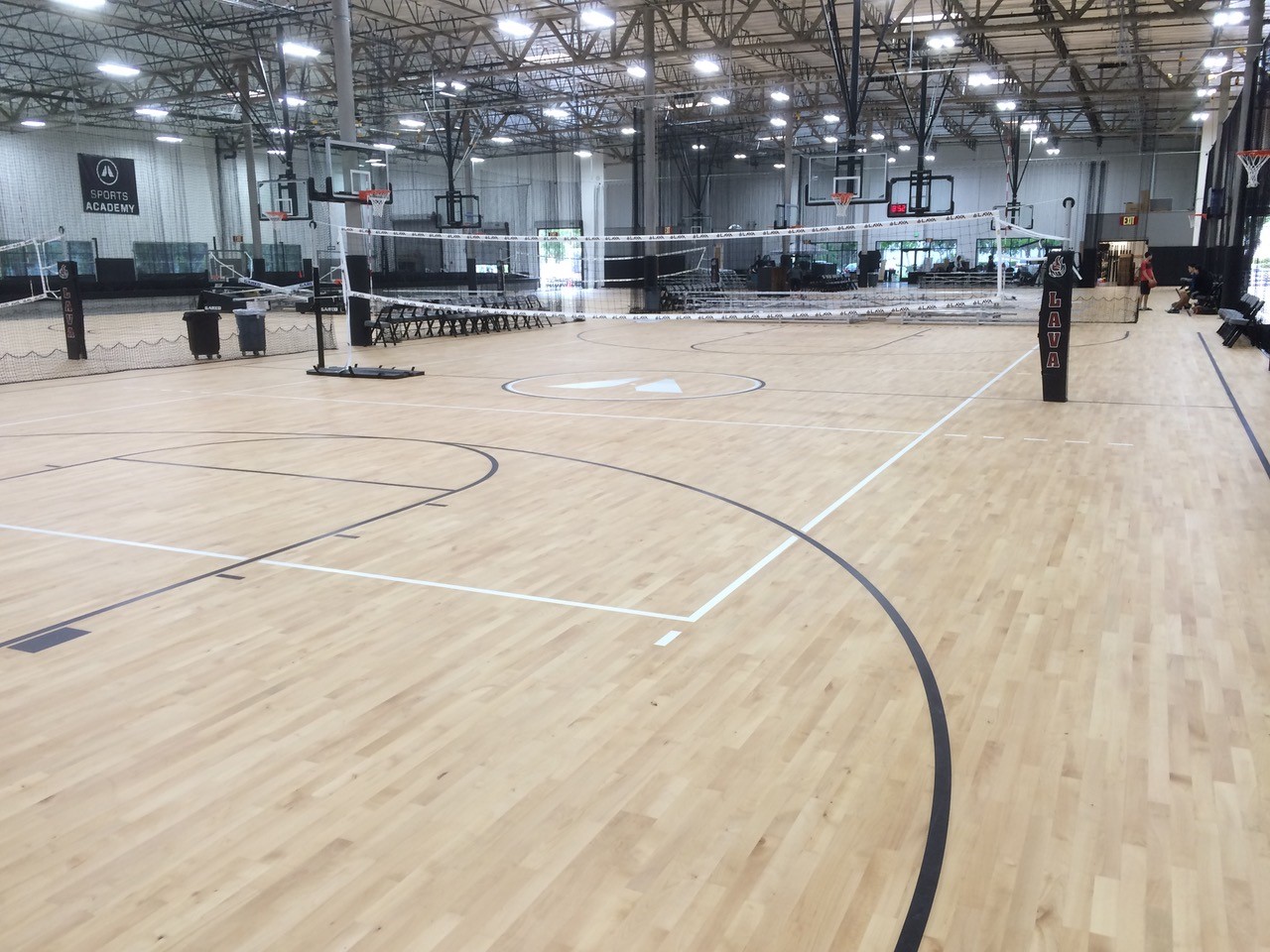
4. Letting Line Markings Become a Mess
Multi-use hardwood courts need multiple line markings.
But too many lines can turn flexibility into confusion.
Basketball. Volleyball. Pickleball. Badminton. Training zones. Half-court layouts. Tournament setups.
Stack too many colors and overlapping markings on one floor, and players hesitate. Officials get complaints. Customers follow the wrong line.
Before installation, decide which sports are core to the business and which are occasional.
The line-marking plan should support the programs that actually drive revenue. Not every activity someone might someday request.
A good multi-sport hardwood floor is clear, flexible, and easy to read.
5. Focusing on the Surface and Forgetting the Subfloor
The surface gets the attention.
The subfloor does much of the work.
A hardwood sports floor is a system. Beneath the visible surface, the structure below affects shock absorption, stability, ball response, and long-term durability.
That can include sleepers or battens, resilient pads, floating systems, clips, and other components designed to help the floor respond properly under load.
This matters when athletes jump, land, sprint, and cut all day.
A poor subfloor can lead to inconsistent performance, faster wear, and more maintenance calls. It also changes how the floor feels underfoot.
When reviewing flooring proposals, ask what is underneath the hardwood surface. Not just what the sample looks like.
6. Forgetting That Downtime Costs Money
In a private sports facility, a closed court is not just inconvenient.
It is lost revenue.
Full-court rentals can run from $65 to more than $200 an hour, depending on the market and facility. A weekend tournament can book a court for ten or twelve hours straight. Take that court offline for unexpected repairs, and the losses add up fast.
If a court normally rents for around $100 to $150 an hour, losing a few evenings of league play and one weekend tournament can easily mean thousands of dollars in missed revenue.
And that is only the direct rental loss.
It does not include refunds, staff disruption, canceled concessions, shortened camps, rescheduled games, or customers who book somewhere else next time.
For a private facility, downtime is not an abstract maintenance issue. It hits utilization, customer experience, and cash flow.
That is why lifecycle planning matters. Some floors cost less upfront but require more frequent replacement or more disruptive repairs later. Solid hardwood sports floors often cost more at installation, but they can be sanded and refinished repeatedly.
Downtime also matters when a facility moves. A permanent hardwood court may need to be abandoned or demolished. A relocatable hardwood sports floor can preserve more of the original investment.
The cheapest floor on day one can become the most expensive floor in the building if it takes your best court offline during peak season.
7. Ignoring Climate Control and Moisture
Wood is a natural material.
It responds to temperature and humidity.
That does not make hardwood a problem. It means the building environment matters.
Sports facilities deal with changing conditions: doors opening all day, HVAC cycles, seasonal humidity, wet shoes, cleaning routines, and heavy traffic.
For hardwood sports floors, proper acclimation, slab moisture testing, expansion allowances, and indoor climate control are essential.
These details belong in the conversation before installation. Not after the floor starts moving.
Get the installer, manufacturer, and maintenance team aligned early. A good hardwood sports floor needs a good environment to perform.
8. Treating Maintenance Like an Afterthought
Maintenance protects the investment.
A high-use facility needs a clear plan for cleaning, inspections, recoating, refinishing, and long-term care. Without that plan, even a well-built hardwood sports floor wears faster than it should.
Before choosing a vendor, understand what daily care looks like, when the floor will need recoating or refinishing, how long that work will take, and what is required to keep the warranty valid.
A durable hardwood sports floor is not maintenance-free.
It is maintenance-manageable.
That matters most when the calendar is full and every closed day has a real cost.
Hardwood Sports Flooring Questions to Ask Before You Choose
Before comparing quotes, ask five questions:
- Which sports and programs will drive the most revenue?
- Does the floor support full-day, multi-sport use?
- Can the floor adapt if the facility expands, reconfigures, or moves?
- What subfloor, safety-zone, and line-marking decisions affect performance?
- What maintenance, downtime, and lifecycle costs should be planned for?
The Real Cost Shows Up After Installation
A hardwood sports floor is a business asset.
It decides what programs you can offer. How often the space can be booked. How athletes experience the facility. How much downtime the business can afford.
For leased facilities and growing sports businesses, it also affects whether the flooring investment stays useful when the business expands, reconfigures, or moves.
The best hardwood sports flooring decisions look past the sample board and the initial bid.
They account for safety zones, line markings, subfloor design, climate control, maintenance, downtime, relocation potential, and long-term revenue.
Because the real cost of a hardwood sports floor is never just what you pay to install it.
It is what happens every day after.
